

 Deerfield Dirt Road Randonnée (AKA D2R2 )
The Retro Randonnée Ride
By Melinda Lyon
Photos by Melinda Lyon, John Bayley, and Ted Lapinski
Scroll down for a video of the 2008 event by Mike Bulda.
Related Links:
D2R2 Website
Photos by pro photog Ben Barnhart
Melinda at P-B-P 2007, which she completed in 56:33
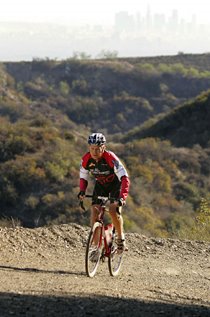
August 23, 2008 marked the 4th annual Deerfield Dirt Road Randonnée Ride. I first heard about this ride early in the summer of 2005 and was intrigued from the outset. Some folks in Western Massachusetts had set up a century ride composed primarily of dirt roads.  This event, according to the website www.deerfieldcycling.org, was constructed with the early days of pro cycling in mind. The roads then were unpaved and the suffering was enormous with primitive bikes (by today’s standards) and muddy, dirt roadways. Western Massachusetts still has a network of dirt roads, loosely maintained seasonal roads and abandoned right of ways. The idea for this event was, why not run a century ride on these roads for those riders inclined to some suffering and looking for something outside the box?
To accommodate the less ambitious, the organizers offer a 100K route that is somewhat more forgiving to the less experienced cyclist. The final mileage on the 100 mile route tops out at closer to 112 miles, with 16,500 feet of climbing, so a 6AM start time is set to give riders the maximum daylight to finish the punishing route.
The brainchildren of this ride are a group of experienced and talented cyclists from the local area. Saunders Whittlesey and Don Podolski have participated in and organized cycling and ultra marathon events in New England and beyond. Don is the Berkshire Brevet Administrator and Saunders is a rider to top all riders. Twice a champion of the Boston-Montreal-Boston 750 mile randonnée ride, he smashed the course record on that ride in two consecutive years and still holds that course record. While a great rider, Saunders is an amazingly down to earth person and very supportive of “the rest of us” who only see him briefly before he rides away at the start of long distance events.
In the weeks before the ride every year there is always a lot of e-mail chatter about the proper bike and tires for such a ride. Saunders tells us that a road bike with beefed up tires (28-32cc) would be adequate if conditions were dry. I had purchased a Rivendell Rambouillet in the spring of 2005 and rode this bike for the first 2 years of D2R2. This year I had a new Redline cross bike to satiate my increased interest in this kind of ride. I had developed an enormous curiosity to find dirt roads that are fun for cycling. In fact, I developed a similarly themed, if not nearly as hard, ride in my local area that I have just started to offer as a ride to like minded folks.
The weather forecast for the 2008 ride was for perfect late summer, dry and warm conditions. New England had a very soggy summer and the condition of these dirt roads was in question. There was a wide range of bikes at the start, including full suspension mountain bikes, heavy duty touring bikes, road bikes with 28-32mm tires, and a lot of cross bikes.
The ride starts at its lowest point, the Deerfield River (150 feet), so the ride only goes up from there. The ride is listed with 11, 500 feet of climbing and 70% of the ride is on dirt roads. (As I mentioned above, the climbing is far more than the “official” amount.) It was a beautiful morning and the first dirt section with climbing came right away. I was surprised at the early pace some wanted to keep, but I wanted to relax, enjoy the scenery, and hopefully get back before dark. There were a few ups and downs before the first major climb to Poland Gate (1260 feet) at mile 12. This is followed by a short descent before a major climb to up to Hawley topping out at 1800 feet. So far the climbs were steep but the mixture of dirt and pavement had been relatively kind and the scenery was fabulous. Old farms, older stone walls, and tunnels of old growth trees lined the roads. My Redline was performing well and the big 35 mm tires were holding the gravel and dirt well. Everyone seemed to be relishing in the early morning fresh air, knowing that the day would be become cruel before long. The descent all the way back down to the river valley in Charlemont is steep and always has some loose gravel. Several riders pinch-flatted on this section (I had done this myself a few years back).
The descent to the river valley and Rt 2 is followed by a steep and paved then dirt ascent to our first checkpoint at Heath, Massachusetts at almost 1800 feet. A breathtaking view was our reward for a tough climb. The next section is reported to be the toughest and it always lives up to that reputation. A very rough section of road continued our climb to Heath Center. The cue sheet says “25 percent climb” at the Archambo Wall. Sure enough, it is a wall with loose dirt to boot, so I bailed out early and walked up most of the 200 yards. My low gear of 34-27 is not enough for this monster. Plenty of riders make it up this with higher and lower gears than me but I am old enough not to worry about it.
Next came Christian Hill, which some say is the toughest of the ride. Loose gravel and an unrelenting grade usually make this too tough for me, but all of the rain during the year have washed some gravel away and make it almost bearable. Some soft dirt, a few wheezes, and the top is mine! There were even some playful Arabian horses at the top of this hill also taking in the summit views.
We soon crossed the state line into Vermont and had a long gradual climb to the highest point on the course at Deer Park (1950 feet). A few rollers, good, hard dirt and some pavement led us into the 2nd checkpoint at the Green River covered bridge. On such a pretty day there were lots of chances for pictures at this scenic red bridge. The idyllic lunch spot was at the river level so that meant another climb to Owl’s Head Mountain (1400 feet) and then back into Massachusetts.
The last third of the course seems to have more pavement and a net downhill so the miles go by more quickly. There is a long, paved downhill in West Leyden, Mass, and then a left onto Green River Road. This was a nice gradual descent next to the river over hard, smooth dirt. Then time for another climb up to Copeland Hill (1130 feet) and yet another spectacular view.  The last mega climb comes at 100 miles. Patten Hill is 1000 feet of climbing in just under 1.5 miles. Thankfully the steepest part is paved (20% grade) but the top is really tough. The grade is a steady 15% with a few small flattish breaks but the accumulated miles of the day plus the loose gravel make it pretty punishing.
  I have been determined to make it all the way up this last big climb without walking every year and I succeeded again this year. The reward is an open summit of fields and a beautiful farm with views over to Mt Snow in Vermont. We had our last checkpoint at the top. It is nice to take a breather and admire the views, but there are still a few miles to cover.
The last 16 miles are anything but easy. There was a steep descent down to Rt 2. At the 100 mile point I try to check my “century time.” In the inaugural year of this ride we got to the century mark at 4:30PM. My friend Kris Kjellquist stated proudly that this was his “personal worst” century time of 10.5 hours. The Deerfield town line is an engaging reminder that the end is near but not quite yet. The cue sheet encourages one to ignore a road closed sign and “begin gnarly descent, large stones and washouts, next mile.”  This last section is really slow going but by now the end is near and it is just a matter of time. One wonders what other surprises the ride will throw at you with so little time left. Finally we dropped back into Deerfield for the final 2 miles, thankfully flat, smooth and paved. In the first years there wasn’t much fanfare upon finishing. Now, the ride has been combined with a local farm/music festival so the atmosphere is very festive. There is time for a cold drink and a meal and perhaps to swap war stories of the epic just completed. Every year I drive home dusty, dirty and tired. The bike is muddy and dusty. But I always have a huge smile on my face that I keep for a few days after.
Melinda has done long distance cycling-racing for 20 years. Her first ride was a 24 hour event in 1988. Since then she has done 4 PBPs (2 first female placing), 6 BMB's, many brevets, and she is the course record holder at the Saratoga 24 hour event. She commutes to work 9 months of the year and tries to limit the use of the one vehicle in her household. She works 40 hours a week as a cardiac technology specialist in invasive and non invasive procedures. She will be 46 years old in October 2008. She doesn't have a website for the current ride she's organizing (next scheduled for Oct 18th) but folks can contact her directly for information about the ride. It is 80 miles with 18% dirt, 2 major water crossings and lots of mud. Not much traffic, especially by Eastern Mass. standards! Melinda's email is melindalyon "at" verizon dot net.
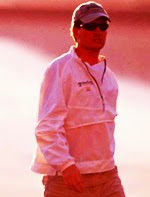
Here's a recent photo of Melinda:
Sunday, September 14, 2008
Deerfield Dirt Road Randonnée (AKA D2R2 ) by Melinda Lyon

Friday, June 27, 2008
Rough Riding in Competitor Magazine
 Chris Kostman: Who Needs Him?
Lots of Us – This Ultra-Athlete Organizer Knows How to Take You to the Limit.
By Roy Wallack, July 2008 issue of Competitor Magazine
In April 1988, for one of my first articles as a journalist, I was doing a handicap of that summer's Race Across America for the regional, now-defunct California Bicyclist magazine. None of the contenders I interviewed was a household name. Everyone pretty much said the same thing: "I've been training 400 to 700 miles a week, there's lots of competition this year, and I'm going out to win." No one's words or personality really stood out.
Except for one guy: Chris Kostman, a U.C. Berkeley junior who'd finished the race the year before as a 20-year-old, making him (then) the youngest-ever finisher and a celebrity in his hometown of Glendora. His personality was way beyond confident. Kostman said his unusual training method, which entailed riding a ridiculously low number of miles per week compared to everyone else, plus his unusual diet, composed of substances apparently only known to NASA astronauts, plus his super-secret sleeping method, known only to Himalayan monks, would make him the uncontested star of the 1988 race. His ride would not only obliterate the field, but so revolutionize RAAM and ultra-endurance cycling in general that people would be writing about it for years, studying it as if it were a guide not just to cycling, but to a new level of human consciousness.
When I put the phone down after the interview was over, I said to myself, "Well, that young guy has to be the most arrogant, self-admiring, self-congratulatory narcissist I think I've ever met." Then I thought, "He's kind of cool."
After all, nothing Kostman said was offensive, really. He was pretty interesting and actually quite respectful of the other riders. He just thought that he was really good and really smart – and he had the resume to back it up. Who doesn't want that kind of self-image?
Four years later, while I was editing the national, now-defunct Bicycle Guide magazine, (see a pattern here?) Kostman called me up to pitch a story idea. When I mentioned that I was writing a big 16-page review and feature article about the explosion of affordable front-suspension mountain bikes – a big deal in 1992 – he scoffed.
“Mountain bikes are the most over-hyped, overbuilt piece of equipment ever created,” he said. “I dust every mountain biker I see on the trails, and I ride a road bike!”
There it was again, the arrogance – the weirdly intriguing, over-the-top, strangely compelling arrogance. But again, he was more interesting than offensive, and could always back it up. Although he hadn't finished the 1988 RAAM due to a pinched nerve in his neck, the next year he set the world's first 24-hour mountain-biking record of 242 miles. And, as proof of his off-road prowess, he came down to L.A. a couple days later and took me out on the trails in the Santa Monica Mountains. He rode a Bridgestone XO-1 road bike with odd, S-shaped “mustache” handlebars.
“Hey,” I said, “Why don't you write me a story about how your skills are so honed that you can beat any mountain biker on your road bike? I'll run it next to my mountain bike story just to mess with people.”
Kostman's story, Mountain Bikes: Who Needs Them? drew 268 letters and faxes. That's more than the total number of letters the magazine had received all year. They came from average weekend warriors and bike industry titans. Everyone basically called Kostman the most egomaniacal jerk they had ever run across. One fax, addressed “Kostman sucks” was simply a drawing of a large hand with the middle finger extended. The last letter summed it up thusly: “Kostman makes some good points. Too bad he's such an A-hole.”
He loved it. I loved it. I ran the most scathing letters in the next issue, calling them an article on their own. At bike industry gatherings months later, everyone was still talking about Mountain Bikes: Who Needs Them? And everyone was reading the magazine.
I figured I'd better get to know this guy. And over the 20 years since I first interviewed him, I've seen Chris Kostman carve out a multi-faceted niche that is unique in cycling and endurance sports. He's a record-setting athlete with a penchant for crazy events like the Iditabike and the Triple Ironman; a trend-spotter and coach who rode the L.A. personal-trainer wave like John Travolta in the movie Perfect, and helped turn a local trend called Spinning into a world-wide phenomenon; and an entrepreneur who's built endurance events that are among some of the most sought-after by athletes from all around the globe, including the Badwater Ultramarathon and the Furnace Creek 508.
Kostman is not a celebrity like Lance, and he's largely unknown to general public, but he's one of many crucial behind-the-scenes links in a chain that makes the endurance sports scene thrive. And best of all, he hasn't lost the attitude, that oddly ingratiating arrogance that he exhibited in a ten-minute phone call two decades ago. In fact, it's clear that he's succeeded because of it.
FAR-OUT FROM THE START
“We're Out There,” is the slogan of Kostman's events company, AdventureCORPS. It fits, because even as a kid, he was out there.At 13, on a yearlong driving trip around Europe and North Africa with his adventurous parents (both teachers on sabbatical), he dipped a toe in the Arctic Ocean and climbed one of the great pyramids at Giza. The trip left him with more than a nice photo album. “It made me realize that I don't want to wait to engage the world until I'm 70,” he says. When he got home, he started engaging it by bicycle.
At 14, in 1982, he caught the ultra-bug that would ultimately define him when he saw the Great American Bike Race (soon to be known as RAAM) on ABC's Wide World of Sports. Inspired, he biked from his Glendora home to Mt. Baldy and back, a 50-mile trip. “That day changed me,” he says. “I discovered that in a few hours or more you could have a really meaningful experience that's exciting, interesting, engaging and enlightening. I didn't want it to stop.”
Soon, while other kids were hanging out at the beach, he was pedaling there on a bike – a 100-mile round trip.
Columbus Day in 1983 was a pivotal day for Kostman. At a bike race, he spotted his idol, the guy he'd seen on TV: John Marino, the two-time transcontinental record holder and founder of RAAM. “I walked up to him and told him my dream, to set a record riding a bike from San Francisco to L.A. People were setting all kinds of ultra-cycling records then, and I found out that there was no record for that.”
Marino was tickled that a 16-year-old kid had such big dreams. "He said, 'Really?'" recalls Kostman. “Then he wrote his home phone number on a business card and said, 'Call me.'”
It was the beginning of a long, successful relationship. Marino got young Kostman into the industry bike show in Long Beach and gave him lots of contacts and promotional ideas. “I was blown away," says Kostman. “It'd be like a high school basketball player meeting Kobe Bryant, and Kobe taking him under his wing.”
A year later, Marino made Kostman an honorary lifetime member of the Ultra-Marathon Cycling Association after the 17-year-old set a world record by riding a bike from San Francisco to Los Angeles in 31 hours and 13 minutes.
That record established a pattern for Kostman, of setting records at things no one had ever thought of before. A week later, his S.F.-L.A. record was broken, so Kostman set a new one of 22:38 in 1985. A month later, that mark was also broken by Michael Shermer, another RAAM founding father. “I was so honored – another one of my idols, beating me at an event I came up with,” said Kostman, who still owns one world record: the 24-hour tandem off-record of 245.23 miles, set with Bay Area bike shop owner Ed Levinson in 1990.
With RAAM riders as heroes, it was just a matter of time before Kostman geared up for the big one himself. At age 20, while other college kids were chugging beer and partying all night long, Kostman was riding all night long, setting a new “Trans-California” speed record from the Huntington Beach pier to the Colorado River. Months later, backed by a promotional campaign with a local bank that is still legendary in ultra-cycling circles, he become the youngest RAAMster, finishing the grueling 3,127-mile route from San Francisco to Washington D.C., the longest and most mountainous ever, in 10 and 1/2 days, good for ninth place.
Hoping to "traverse land more home to moose than man," the certified scuba-diving instructor and Berkeley Master's degree holder (in Arabian Gulf Archeology – he speaks fluent French and passable Hindi) headed for Alaska, racing the snowbound 200-mile Iditasport mountain bike race in the winters of 1988, 1989, and 1991. He then opted for the 100-mile snowshoe division, finishing three races from '93 to '96. Two 11-hour Ironman triathlon finishes in the early 90s naturally led to extreme events few sane people dare: the 1993 Triple Ironman in France (53 hours, 27 minutes), and the Vermont Earth Journey (a 5.5-mile swim/263-mile bike/51-mile run).
Although Kostman was diving for wreckage in the Red Sea and pursuing his Ph.D. during the early 90s, he was never serious about an academic career. “For me, life is all about exploration and learning and getting out there. I purely was interested in college for the adventure, intellectual challenge, and for any possible contribution I could make – not for a career,” he says. “The chance of getting a teaching position in archeology is slim. I never thought I could make a living doing that. And I didn't want to take a job in some little backwoods college town.”
Plus, he was already starting to earn a living from cycling by then. “I was producing races while I was in college,” he says.
In the fall of 1990, while working on his Master's, Kostman organized the Furnace Creek 508, a 508-mile qualifier for RAAM once known as the John Marino Open. A crazy-hard challenge that blitzes northeast to southeast, from Santa Clarita to Death Valley and the Mojave Desert, the 508 has grown from a RAAM qualifier with 25 soloists to an independent event with 100 soloists and 150 relay racers. Based on his 508 success, Kostman created Team RAAM in the summer of 1992; it grew exponentially for five years until RAAM organizers, noting its success, reabsorbed it and squeezed him out.
From 1993 to 1995, an old friendship with fellow RAAM competitor Johnny G made Kostman part of the team that developed Spinning, the now-ubiquitous indoor cycling class. Hired to organize the first Los Angeles Marathon Bike Tour in 1995, he spent the next few years teaching Spinning classes at Sports Club L.A., creating and managing a cycling program for the Bodies in Motion chain, and traveling the world training instructors.
Kostman began transitioning out of the gym when his reputation for well-organized races in Death Valley led to requests for him to take ownership of marquee events like the Badwater Ultramarathon (in 2000) and the biannual Death Valley Century and Double Century in 2001. That year the Juvenile Diabetes Research Foundation (JDRF) also asked him to manage its Death Valley-based Ride to Cure Diabetes. His events have raised large sums for the Challenged Athletes Foundation as well.
His successes have given Kostman the time and resources to indulge in some of the quirky events he enjoys. He's kept up his triathlon bona fides with frequent participation in the standard-distance, 140.6-mile Ironman Revisited race on Oahu in the last few years. In May, he arrived home from a week with his girlfriend at the Lake Pepin 3-Speed Tour, in which all the participants cruise the environs of this quaint Mississippi River lake in Minnesota on old, English three-speed bikes. The next day, after finalizing some details on his new weeklong CORPS Camps (extreme cycling and snowshoe vacations in Mt. Shasta, Death Valley, and Paso Robles), he was off to Worcester, Massachusetts to join Greg LeMond, John Howard, and Edwin Moses for the unveiling of a statue of Major Tayor – the African-American rider who won the 1899 world cycling championship.
Something of an elder statesman due to his early start on the endurance scene, Kostman was given a lifetime achievement award from RAAM and inducted as a Fellow at the prestigious Explorers Club at age 30. “Even now, at 41, it still seems like I'm younger than most of the participants in my events,” he says with amusement.
As for his personality, and the unvarnished, opinionated pontification that used to cause people to call him an egomaniac, Kostman insists he hasn't mellowed with age – “but I have certainly learned how to package my message and present myself in a more constructive manner,” he says, carefully.
Still, he tells it like it is. “I severed my ties with RAAM because I don't like what they're doing to the race and the sport, and I use my adventureCORPS.com website to promote my environmental agenda and the national parks," he says. “The world needs more outspoken people, and I've got a good platform with these events that sell out so quickly. The 508 is bigger than ever. That gives me confidence that we're doing the right thing.” On his agenda for the future someday: a book and a magazine.
Kostman admits that he is still obsessed with a certain incendiary topic that I am familiar with: over-teched, over-hyped bikes – especially mountain bikes. Kostman recently started a new blog, Rough Riders (www.XO-1.org), just to extol the simple joy of using one bike to cover all kinds of surfaces. “Rough Riders is actually the evolution of that article, Mountain Bikes: Who Needs Them?” he says. “My biggest gripe is that cycling is fixated on racing and technology. But they don't go any faster at the Tour de France every year. Nothing has made anyone faster except aerobars.”
“Funny thing, after 15 years, I still get emails about that story,” he says proudly. “People have told me that it changed their lives. It said that the bike is secondary to the experience; that less can be more; that you can have a better experience getting more in touch with the landscape in a more real and authentic way. It's easy – I just swap out the 700C wheels on my Ritchey Break-Away (fold-up road bike) to 650B wheels with a 32-diameter tire, and it opens up the possibilities of what you can do – road, dirt, rocks, sand, anything.
“After all, short of a big rocky drop-off, who needs a mountain bike?”
Roy M. Wallack is the co-author of Bike for Life: How to Ride to 100.
Click here for Roy's article at Competitor.com.
Click here for "Mountain Bikes: Who Needs Them?"
Tuesday, May 6, 2008
Mt. Laguna: Beauty and Curiousities Abound
Truly one of California's best kept secrets of the outdoor world is the area on and around Mt. Laguna, the 6,000' peak in eastern San Diego County. The cycling there, on and off road, as well as hiking, bird watching, flower-spotting, animal-seeking, camping, and much more, are just unparalleled. Encompassing Anza-Borrego State Park and the Laguna Mountain Recreation Area of the Cleveland National Forest, it's a beautiful, gorgeous, wondrous place to explore, enjoy life, and get way out there - all the while just 50 miles east of San Diego! Here are a few shots and a video from this past weekend. That's right, all this beauty was captured on just one day, while road cycling on Kitchen Creek Road and Sunrise Highway and hiking on the Pacific Crest Trail. ("Rough riding" plans were waylaid by "private property" and "park closed" signs. But stay tuned for some rough riding pix from other adventures out there!)
The odd first pic depicts a critter ignoring the "no spaceships" sign painted on the lower Kitchen Creek Road gate. Some of the other photos depict the "Spanish Bayonette" which is featured in the Rough Riders logo. As for the beautiful flowers and plants in the other photo, perhaps some expert out there can illuminate us as to their identity? (Click "Comments" below to enlighten us, please!)


 All photos and videos ©Chris Kostman
Kitchen Creek Falls:
Tuesday, April 29, 2008
Any Bike, Anywhere goes to Shanghai
Rough Rider Jeff "Jaguar" Martin gets the opportunity to ride all over the planet, thanks to his job as a Fedex pilot, where he flies the MD-11. Recently he flew to China and joined a guided mountain bike ride near Shanghai. Was he with a group of totally hard-core mountain bike junkies on the latest hi-tech cycling weaponry? Nope. But the spirit of "any bike, anywhere" runs strong through the Jaguar, so he joined up with a group of strangers on a rental bike and headed on out for a day of adventure in a truly foreign setting. Being among the stronger riders in the group gave him the chance to get ahead, shoot video, and offer encouragement. What would you expect from a Furnace Creek 508 finisher, Ironman finisher, and regular volunteer at epic sporting events around California? Thanks for sharing your adventure, Jaguar!
 Here's Jeff waving from the cockpit:
 Here's Jeff "in the office":
 Here's Jeff's video of mountain biking in China (our first video post!), direct from his Youtube channel:
 Click here for Jeff's 2000 Furnace Creek 508 report, with tons of photos and more.
Click the Comments button below and tell us about the most "far and away" place you've ever cycled!
Tuesday, April 22, 2008
Mt. Baldy: Where Cycling and Snowshoeing Met
 In 2001 I became the Regional Brevet Administrator for Randonneurs USA (RUSA), organizing long-distance road cycling events which stressed self-sufficiency over routes of specific distances, namely 200km, 300km, 400km, and 600km. As my turf was Southern California, it was my intention to showcase the best that our region has to offer the long-distance cyclist. Since the Los Angeles area is a basin surrounded by a ring of mountains, and because long-distance cycling requires "getting out of town," the routes I created would necessarily escape metropolis by ascending into higher, quieter ground.
The 200km route I created includes one of the very best 50-mile mountain loops anywhere in the country: the Glendora - Glendora Mountain Road - Mt. Baldy - Upland - Glendora loop that I first did at age 14, the day after buying my first "real" bike. Later I used this same route as my primary training grounds for the Race Across America, Iditasport, and Ironman, among others. It's always been a sentimental favorite, too, and I still go ride that loop once or twice a year, even though my parents retired and moved from Glendora to Solvang back in 1996. It’s a pilgrimage for me and one that I looked forward to sharing with the cyclists of SoCal. (I still do.)
And as for all those other miles in the 200km, they would be a really neat tour of the foothill communities of the San Gabriel Valley: Pasadena, Altadena, San Marino, Arcadia, Monrovia, Azusa, and Glendora, among others. Sure, other than the Mt. Baldy loop, it' was "urban riding," but the route traveled through really nice areas, quiet roads, easy to rolling terrain, and not too many lights or stop signs.
In the weeks leading up to our February 17, 2001 200km brevet, all eyes were on the weather. It was raining pretty consistently, as well as snowing at the higher elevations through which we'd be traveling on our way up to Mt. Baldy. But our ride day dawned free of falling water and with semi-clear skies. It would be our lucky day (and an unusual adventure)!
Forty-two riders departed during the one hour window between 6 and 7 am; mass starts are a memory of my early days of cycling, it seems. Since I was busy helping my Ride Director, Scott Scheff, I rolled out with the stragglers. Our point of departure, and finish line, would be the newly rededicated Hansen Dam Recreation Area in Pacoima, in the San Fernando Valley. Just nearby was La Tuna Canyon, a wonderful, building-free and quiet country road that connects "the Valley" to the San Gabriel Valley. Eight miles later we spilled into that other Valley and wound our way through beautiful neighbourhoods and past the world-famous Rose Bowl. Then it was a beeline through the aforementioned Foothill communities, always keeping the majestic and white-dusted San Gabriel Mountains immediately to our left.
Eventually Mt. Baldy (AKA Mt. San Antonio, her legal name) drew us like a magnet, two-thirds of her 10,000-foot body clothed in a thick skirt of bright white snow. The climbing began in earnest not long after the first controle (that's French for checkpoint, where the riders had to get their "brevet card" stamped to prove that they had passed by) in Azusa. From Glendora's 1000 foot elevation, we would climb up and down several times to over 4,500 feet before dropping into Mt. Baldy Village at 4,000 feet.
Our route was simple: climb infamous Glendora Mountain Road ("where I became a man," I like to say), then stay right at the fork and continue on Glendora Ridge Road to the Village. A few miles out of the first controle I realized that I had forgotten both of my water bottles. But luck was with me: we had encountered a group ride of the SCOR Cycling Club and there were several Furnace Creek 508 veterans in the group. We were having a little reunion and one of them, Jerry Wildermuth, gave me a fresh bottle of water (in a 508 bottle, no less). I had about ten riders ahead of me as I reached the halfway mark up the climb to Mt. Baldy, the fork in the road where we were to stay right. I arrived there alone and was shocked to find it gated closed, but no riders waiting there in a confused panic. I thought "if the road is closed, why aren’t they sitting here waiting and wondering?" There was no significant snow on the road, but clearly the road must have been snowed over ahead. But where were the front-runners? As I waited, more riders arrived behind me and stopped. Scott rolled in with the controle van. And soon enough, riders started arriving from the opposite direction, having gone around the gate and continued until they found the road impassable. Although the road report I'd been given had indicated a clear road, it was most assuredly snowed over, I was told. What to do?
I didn't think long. As the rest of our group continued arriving from behind, I instructed everyone to just U-turn and head back for home. Our "lollipop route" would now become a pure out-and-back. This intersection in the road would be controle number 2, instead of up in the Village. Scott signed off time cards while I told everyone "head for home, but when you hit the Rose Bowl, do laps until your bike computers read 117 miles, then finish the course and you'll have 200km behind you." I explained that all the Pasadena area cyclists use the Rose Bowl perimeter as their personal criterium course, so they'd have plenty of company.
Everybody headed back, like cows for the barn. Well, everybody but four of us.
In nineteen years of riding this route, I'd never been turned back, so I wanted to see this "impassable road" for myself. I grabbed my digital camera from the van, mounted my Bridgestone RB-1 road bike, and continued. Debbie, Carmela, and Barclay - riding his HPV - joined me. Sure enough, about six miles from the Village we found the road covered with snow about a food deep. As a seven-time Iditasport veteran and feeling right at home on my favorite road in the world, it was a simple decision for me to continue. My three comrades put their blind trust in me and went for it, too.
We started walking. And walking. And pushing. And walking more. It was slow going. First our bike shoe-clad feet stayed atop the snow, then they broke through to our ankles, then to our shins, then eventually to our knees. What would have taken 40 minutes on the bike was taking hours. And hours.
But it was adventure! And gloriously beautiful!  Trudging forward, we followed the fresh tracks of rabbit, deer, coyote, mountain lion, and bear (and I'm not kidding about the bear tracks; they were huge!) This was obviously the best thoroughfare around, at least for the native wildlife. Meanwhile, not a human being or a human footprint was to be seen, except for our own.
Between us we rationed two Hammer Gels, two Clif bars, a Balance bar and half a bottle of Sustained Energy. Then we ate snow. It was the only water we could have and we were surrounded by, standing in, and staring at tons of it. One big mouthful was only good for one sip, though. We ate lots of snow.
Ultimately, we pushed our bikes through the snow for more than four hours to cover a mere six miles to get to the Village. But it was worth it, so very worth it.
Now, with soaked socks and frozen, stinging feet and toes, we still had 62 miles to go! Wolfing down the only food available in the Village (Doritos, Peanut M&Ms, and Powerade), it occurred to me that most of the other riders were already finished and headed for their homes! Soon we were racing down the down front side of "our mountain" at over 50 mph, chasing the sunset.  We were quickly running out of daylight and, of course, none of us had brought lights. Who needs lights for 200km of cycling in Sunny SoCal? Fortunately we found a Radio Shack along the way and I spent $80 on strobe lights and flashlights to illuminate ourselves and the now pitch-black road. These lights failed, though, and so we found yet another Radio Shack to replace the lights and get more batteries. Market stops stole more time. It had turned into "the longest day," but we didn’'t care anymore. We just wanted to say "we did it."
Needless to say, we were jubilant, and exhausted, when Scott greeted us at the finish! It had taken every minute of the possible allotted time (13 hours, 29 minutes), but we knew that it was an epic way to start the new year and that this is what ultracycling is all about. Thank goodness I took that digital camera; otherwise nobody would have believed us! (And now those longer brevets will seem like a piece of cake!)
Originally published by Chris Kostman in American Randonneur, Volume 4, Issue 2, May 2001.