Thursday, July 7, 2011

JIM SWARZMAN TRIAL STARTS JULY 12

The trial for the hit-and-run driver who killed Furnace Creek 508 veteran and close friend Jim Swarzman starts Tuesday, July 12 in Vista, CA and should last until the end of that week. It is really important to have a very strong cyclist presence to send a message to the judge and jury this type of killing cannot be tolerated any longer.

If you live anywhere in Southern California, please consider attending even one day of the trial. Be sure to wear a Furnace Creek 508 or other cycling jersey, vest, or jacket, so that your identity as a supporter of cyclists' rights is visible. Location:

North County Courthouse: 325 S Melrose Drive, Vista, CA 92801

It is the 5 story building and you will need to check for the actual courtroom upon arrival. Officially it starts at 8:45AM, but they tend to start late. Jim's fiancé, Nicole Honda, says "Even if people can only come for a few hours, it would be appreciated." Please support Nicole, Jim's memory, and our right to ride safely on our roads.

Click here for our main post about Jim's tragic death, and his amazing life.

Thursday, June 30, 2011

The Classic Cyclist, Part Four

Above: Self-portrait of the author with Jim Swarzman during the San Diego 200km Brevet, January, 2011

The Classic Cyclist, Part Four

By Chris Kostman

Click here for Part One, click here for Part Two, and click here for Part Three of this series.

As I explained in the first three parts of this article, cyclists entering the sport of road cycling over the past fifteen or so years have tended to come in by way of mountain biking, triathlon, or fitness, rather than pure road cycling. As a result, most of these “cyclists” lack the knowledge which makes up the foundation of the classic cyclists’ repertoire and which respects the backbone of the sport. The point of this series of articles it to bring these uninitiated cyclists “up to speed.” Continuing with the theme begun in the first three parts of this article, here are some more things the classic cyclist knows and does:

CLASSIC STYLE

The classic cyclist “looks just right” on his bike. The clean and minimalist bike set-up and the spotless, humming drivetrain are mirrored in two additional manners by the cyclist astride the wheel: Attire is neither garish nor loud, nicely fitting (neither “parachuting” nor the dreaded “sausage effect”), and tasteful. Most importantly, the classic cyclist’s posture and demeanour on the bicycle are confident, relaxed, and powerful with a tendency to ride “back on the saddle” with hands either on the bar tops while in traffic or enjoying conversation with another rider, or deep in the drops while pushing the pace. Pedaling style is the very definition of souplesse. As such, the classic cyclist is recognizable by these trademark characteristics even while running errands in street clothes on a 50-year-old three-speed.

FLOW

The classic cyclist flows seamlessly with other cyclists and road users, while smoothly tackling all that the road and trail surfaces dish out. By staying in the moment, relaxed, aware, and paying attention with full peripheral vision and attentive hearing, “obstacles,” hazards, pedestrians, cyclists, and other forms of traffic are taken into account as forward momentum is maintained. She rides smoothly and calmly, whether riding solo, sitting in a group, or leading a paceline. When others are following, road hazards are quietly pointed out with small, but specific, hand signals and gestures (verbal warnings are rarely used). By riding predictably and elegantly, the classic cyclist saves energy, minimizes risk, and flows proactively through the world.

NUMBERS ADD UP TO NOTHING

The classic cyclist does not fixate on mileage on elapsed time, nor elevation gain. In the grand scheme of things, a 100-mile ride is no better nor more worthy than an 87-mile ride. Miles are ridden for the sake of the experience, not to fill a spreadsheet. (In fact, many classic cyclists eschew bicycle computers and training logs.) Likewise, he will stop to enjoy a view, to read a historic marker, to help another cyclist (or motorist), to take a photograph, or to sit down and enjoy a cup of tea at a new, or favorite, café. All such moments are part of “the ride” and are to be savored as much as the hard push up a mountain pass while “putting the hurt” on friends and clubmates.

FINESSE AND BALANCE

Riding no-hands for miles on end, removing or installing booties and leg warmers, and putting on a jacket while pedaling are all commonplace and natural acts for the classic cyclist. Indeed, he can change all pieces of clothing, except for shorts, while pedaling. Stopping for a café or scenic view is one thing, but stopping for actions better done while rolling smoothly onwards is quite another. The skills, balance, and awareness necessary for these classic talents make cycling safer, more graceful, and more rewarding.

THE WHOLISTIC CYCLIST

The classic cyclist is an outdoor athlete who puts a premium on personal health, always takes a broad and selfless point of view, and pursues a soft life’s walk on the planet. Stopping to pick up some trash - especially any items clearly dropped by another cyclist - is a natural, every-ride experience. Running errands by bike, such as stops at the post office and bank at the start or finish of a ride, or actually bike commuting regularly, minimizes her footprint and provides more opportunities to “enjoy the ride.” An attitude of “you only live once” permeates her sense of adventure, her sense of purpose, and her appreciation for all that cycling brings to her life. The classic cyclist lives by the mantra, “if you’re going to do something, do it well.”

##

Chris Kostman has been a classic cyclist since 1982. Besides competing in races as diverse as the Race Across America, the Iditabike Mountain Bike Race, the Triple Ironman, and the 24 Hours of Canaan, he also organizes the Badwater Ultramarathon and Furnace Creek 508 races, as well as the Rough Riders Rally, CORPScamp Death Valley, and a series of four century, ultra century, and double century rides in California. Kostman is regularly seen on the roads and trails of California and beyond, riding brevets, centuries, bike tours, and other events and adventures. Learn more at www.adventurecorps.com.

Above three images: The author and his Rivendell Roadeo prior to the 2011 San Diego 200km Brevet.

Monday, April 11, 2011

Jim Swarzman, RIP: My Kind of Guy, and Cyclist


Above: Jim Swarzman and Nicole Honda at the 2009 Furnace Creek 508 finish line, and then Jim a year later in 2010 with his "classic bike" of choice (which will appear as a full-page in the next issue of American Randonneur and in Bicycle Quarterly.) Look at how happy, fit, and fresh he looked after those grueling races! That's testimony to Jim living life to the fullest, embracing all it has to offer, training seriously, seeking out adventure and fun, AND enjoying the ride with his great friend and love of his life.

Fellow cyclist Jim Swarzman, age 47, was killed by a hit-and-run driver in blue or dark color pick-up truck*, possibly intentionally, while cycling in an unsupported 600km long-distance cycling event called a "brevet" early yesterday morning (April 10, 2011) in Leucadia (part of Encinitas, in San Diego County). Here are three media reports about this tragic incident which was no "accident":

NBC San Diego

10 News San Diego

Fox 5 San Diego

Biking in LA Blog

North County Times: Nicole's Words


Memories of Jim, posted by the San Fernando Valley Bicycle Club

Jim Swarzman was a really great guy, and recently engaged to another brevet rider / Furnace Creek 508 racer, Nicole Honda. They were to be moving into their new home together next weekend and were going to ride Paris-Brest-Paris this summer on their honeymoon. They have both raced The 508 on a two person team, and solo, including in the classic bike divisions. I really, really like Jim and we connected on many levels. We talked about all kinds of things while cycling, but never about work. I don't even know what his career was; we were friends beyond those mundane things. (I did think it was very cool that he had been president of a Porsche Car Club for many years. I believe he told me that he had owned as many as six Porsches at one time. But nowadays he had become a much bigger fan of collecting, and riding, bikes.)

Jim had been a bike racer back in the 80s, had got away from cycling for about twenty years, then recently rediscovered it with a passion, meeting Nicole in the process. When I first rode with him, I could tell that he had old school, classic style, because of his position on the bike and form. I loved watching him ride and had the pleasure of riding the San Diego 200km brevet with him earlier this year, plus a few hours of the LA 300km brevet a few weeks later. Even after 20 years away from the sport, he truly rode like a pro, gracefully, strongly, with a relaxed, but precise style and posture. He had really gotten into cycling with a vengeance at this point in his life, riding brevets, double centuries, Furnace Creek 508, plus creating epic rides to go do with friends. He was 100% my kind of guy, on and off the bike.

Jim was living life to the fullest, was very fit, good looking, and in Nicole Honda had found an amazing cyclist, and lovely, bubbly, outgoing, and extremely positive life partner. They were a match made in heaven, truly.

Jim was riding with Nicole, along with fellow distance cyclist Chris Hanson, when he was struck by the hit-and-run driver. He was airlifted to a nearby hospital, but passed away a few hours later.

Thursday, April 14th 2011 at 12 Noon, there was a memorial for Jim at Mount Sinai memorial Park. I was there, along with a great crowd of family, friends, and fellow cyclists. An image from the occasion:

UPDATE, April 12, 2011: Jim's killer has turned himself in. Story here. We will need to follow this closely and see what kind of "justice" is served. For any court event that is public, I hope there is a large contingent of cyclists, and friends and family of Jim's, in attendance.

*"Investigators originally described the pickup as a blue, late model Ford F150. Monday afternoon, after further investigation, they said that the vehicle that hit Swarzman was a 2007-8 Dodge Ram 1500 or a 2007-9 Dodge Ram 2500 or 3500." PLEASE call the Sheriff at 760-966-3500 if you saw anything or have any information.

Here is Jim's Facebook page.

Jim's athletic resumé, as submitted with his Furnace Creek 508 applications:

2009 FC508: 2x Mixed Classic Bike, Team Golden Gyrfalcon, 1st place in division
2010 FC508: Solo Classic Bike, Gyrfalcon, 2nd in division to overall winner, 17th overall

- 5x Super Randonneur since 2009
- First to finish at PCH Randos' 200K & 300K in 2010 and 2011
- 2009 Gold Rush 1200K finisher
- 2010 Central Coast 1000K finisher
- 12 double centuries in 2009 and 2010 incl. Devil Mtn and Alta Alpina 8-Pass
- Top ten at Central Coast DC and Heartbreak DC in 2010
- Cat 3 racer for Velo Club La Grange in mid-late '80's. Finisher at Death Valley - Mt. Whitney Road Race, Whiskey Creek Stage Race, and Tour of the Gila.
- UCLA Cycling "A" Team member in college. Golden Hammer winner (UCLA Cycling TT champion)
- 4x finisher L.A. Triathlon and a number of other Olympic and sprint distance triathlons
- 800 meter runner as junior. Junior Olympic champion and #1 ranking nationally in age group.

- Realize that none of this is particularly impressive other than finishing the 11/09 Rough Rider ride!!!!!

- I am determined, always prepared, and am very fortunate to never have any "show-stopper" problems. Oh, and I am unfazed by extreme heat or cold, and maintain complete mental clarity when sleep deprived! I HAVE NEVER "DNF'd" ANYTHING!!!

Here are Jim and Nicole from the 2009 Furnace Creek 508, which they raced in the two-person classic bike division (Their 2009 Time Splits):

Here is Jim from the 2010 Furnace Creek 508, which he raced in the solo classic bike division (Here as his 2010 Time Splits):

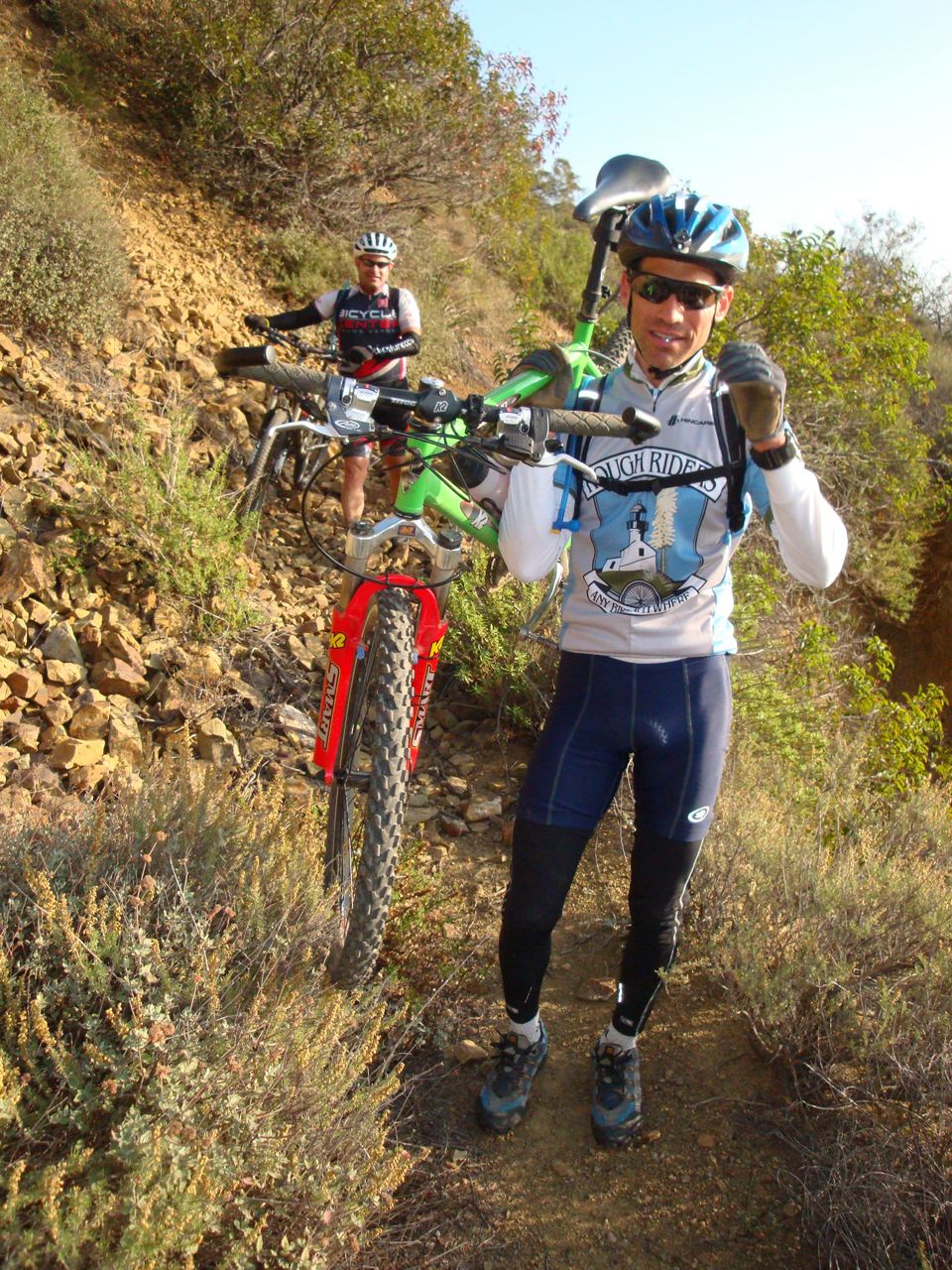
Jim also joined some of our Rough Rider adventures in the Santa Monica mountains. He's in the Rough Riders jersey below and in this report.
THE FUTURE OF RANDONNEUR CYCLING
I've been saying for years now that these Los Angeles / Orange County / San Diego brevets, especially the longer ones, are just too dangerous, with too much traffic, little or no shoulders. and routes which pass too many Indian casinos, bars, and such. There literally are not enough "good miles" in this part of the state for rides this long. Add in relentless "development," increasing numbers of cars on often dilapidated roads, and seemingly more and and more impatient, self-important drivers in over-size, overly powerful vehicles and you end up with an extremely dangerous mix in which a death like Jim's was sadly inevitable.

I'm going to Montana for my 400km brevet and mostly like to Seattle for my 600km. if I even do those rides. I also intend to start lobbying RUSA (Randonneurs USA, the governing body of this type of long-distance, unsupported cycling) to much more carefully scrutinize the routes for the various events around the country, especially those in and near metropolitan areas.

Jim's is not the first death during the brevet; tracking of accidents and deaths needs to be done to learn what truly makes a route "safe," or dangerous, and guidelines need to be created to require brevet organizers to createdroutes which are as safe as possible. Several brevet organizers have literally told me that they only organize brevets because they don't want to travel somewhere else to ride them, and that they just route them from, or from near, their own home, because that is most convenient. The recent brevets which toured all over Los Angeles, Orange, Riverside, and/or San Diego counties are perfect examples of the types of routes which should never have been created.


Jim Swarzman with Chris Kostman during the 2011 200km San Diego Brevet.

L-R, four Furnace Creek 508 veterans: Jim Gyrfalcon Swarzman, Andi Butterfly Ramer, George Red-Eyed Vireo Vargas, and Adam Rock Rabbit Bickett at the conclusion of the 2011 200km Brevet in San Diego.

ADDED JULY 7, 2011: JIM SWARZMAN TRIAL UPDATE

The trial for the hit-and-run driver who killed Furnace Creek 508 veteran and close friend Jim Swarzman starts Tuesday, July 12 in Vista, CA and should last until the end of that week. It is really important to have a very strong cyclist presence to send a message to the judge and jury this type of killing cannot be tolerated any longer.

If you live anywhere in Southern California, please consider attending even one day of the trial. Be sure to wear a Furnace Creek 508 or other cycling jersey, vest, or jacket, so that your identity as a supporter of cyclists' rights is visible. Location:

North County Courthouse

325 S Melrose Dr

Vista, CA 92801

It is the 5 story building and you will need to check for the actual courtroom upon arrival.

Officially it starts at 8:45AM, but they tend to start late.

Jim's fiancé, Nicole Honda, says "Even if people can only come for a few hours, it would be appreciated." Please support Nicole, Jim's memory, and our right to ride safely on our roads.

Saturday, April 2, 2011

Santa Ynez Valley / Refugio Road / Gaviota / Alisal Road Rough Riders Loop

Solvang and its setting, the Santa Ynez Valley, has been a favorite cycling region of mine for 30 years now. Today I rode a loop which I had never done before by piecing together a few different previously ridden routes and connecting them with one excellent 3.25 mile dirt road ascent.

The start/finish is the Santa Ynez Valley Coffee Company, in the corner of the Nielsen's Market parking lot adjacent to the intersection of Alama Pintado and Hwy 246. This is immediately east and downhill from Solvang's city center.

My Garmin 300xt clocked the route at 39.5 miles, though a Google Maps recon of the route the night before said it would be 44 miles (that Google route seems to throw in some short fire road sections in the mountains which don't exist, or aren't really part of this route). You can see all the stats below, but there's even more detail, not to mention the GPS file download, over on my Garmin page for the ride at this link.

It was a foggy day, so I didn't carry a camera or prioritize photography, even though it was still beautiful out. The mustard along both sides of the roadway during the descent to Refugio Beach was incredible, standing up to ten feet high. Above are the only two shoots I took, of my Rivendell Roadeo, as the pavement turned to dirt as the road started to pitch uphill on Refugio Road.

My gearing is 11/28 rear and 39/48 front with Dura Ace ten-speed. Tires are Challenge Paris-Roubaix (700 by 29mm). These were some of my first rides with the new Ritchey Classic Silver bars, stem, and seat post, as well as with the Berthoud "Touring" saddle and HandleBra leather bar tape, all of which I really like. A full post will follow soon about the Roadeo, which is now 99% "finished" and ready for all that awaits.

Route Sheet / Description:
0.0 Head east on Hwy 246.
1.9 Right on Refugio Road (traffic light at the SYV High School and YMCA).
Note: during and shortly after the rainy season, such as now, anticipate about eight water crossings. Since I have Honjo fenders, I was able to coast through them and not get my shoes or bike wet.
6.2 Pavement ends, but keep your ears pealed for the occasional jeep or enduro motorcyclist.The route is essentially all uphill at this point, and all dirt except for three 50-yard paved stretches. The road climbs about 2000 feet and my Garmin was claiming 10-15% grade most of the time. I passed a few mountain bikers along the way, but didn't encounter any cars.
9.5 Pavement resumes at the top of the mountains. Entrance to the former Reagan Ranch is on the right. Continue straight / right and generally downhill on Refugio Road all the way to the coast.
17.8 (app.) Enter the 101 north (right turn, up the ramp)
34.0 (app.) At the summit of the big ascent, look for and take a one-lane right turn downhill (rather than bombing downhill on the 101).
35.0 (app) Turn right on Alisal Road. You will pass Nojoqui Falls Park, a nice place for water, bathroom, or a break, or even a short ride/hike up to the falls.
39.5 (app). Finish where you started! Please support the local business(es) while you ponder your excellent ride!


Monday, February 7, 2011

The Classic Cyclist, Part Three

Above: The author on 17 Mile Drive in Carmel CA during the Million Dollar Challenge, a seven-day, 620-mile cycling event from San Francisco La Jolla in October 2010 on behalf of the Challenged Athletes Foundation. Photo by Preston Sandusky.

The Classic Cyclist, Part Three

By Chris Kostman


Originally published in Endurance News #73, February/March 2011. Read the full article online here.

Click here for Part One and click here for Part Two of this series. Click here for Part Four.

As I explained in the first two parts of this article, cyclists entering the sport of road cycling over the past fifteen or so years have tended to come in by way of mountain biking, triathlon, or fitness, rather than pure road cycling. As a result, most of these “cyclists” lack the knowledge which makes up the foundation of the classic cyclists’ repertoire and which respects the backbone of the sport. Continuing with the theme initiated in the first two parts of this article from Endurance News #70 and EN#71, here are some more things the classic cyclist knows and does:


SEASONAL APPROACH

The classic cyclist takes a seasonal approach to riding style and fitness variability, understanding that the highest level of cardiovascular fitness and muscular endurance - and therefore cycling ability - cannot be maintained year-round. In fact, different parts of the year lend themselves to different types of riding. As such, a periodized approach to the year is naturally employed, for example: additional cross-training (on and off the bike) in the late Fall, fixed gear in the Winter, base miles as the new year unfolds, more speedwork and club riding in the Spring, then peak events and challenges in the Summer and Fall. The bottom line is a simple understanding that overall health fitness is maintained year-round, but top-level efforts are only possible a few times per year. Riding with the seasons acknowledges this truth and also lends variety to each year’s program or campaign.


OTHER CYCLISTS ARE JUST CYCLISTS, NOT COMPETITORS

The classic cyclist is primarily self-motivated and shares a deep camaraderie with other cyclists on the road. While out riding, cyclists seen ahead in the distance are often overtaken, but they are never passed as if they are competitors in the same race and the finish line is just around the corner. The classic cyclist doesn’t care to “beat” other cyclists who happen to be out on the same roads at the same time. Instead, the classic cyclist will, at the minimum, greet other cyclists and will often engage in conversation with them. When the time is right, the classic cyclist will politely move ahead, or drop back, depending on goals, schedule, fitness level, or whimsy. For pure performance training, the classic cyclist self-motivates by sprinting to city limits signs or other landmarks, or by joining racing-oriented club rides (or throws down the gantlet at special invite rides with other classic cyclists).

TECHNOLOGY IS A TOOL, NOT AN END IN ITSELF

Because the bicycle is used as a tool for exploring the outer and inner universes, the classic cyclist appreciates cycling for the cycling, not for the equipment. The bicycle’s beauty and grace are appreciated for what they offer the rider, but whether there are six cogs or eleven on the rear wheel is insignificant to the classic cyclist. The same goes for shifter type and location. The classic cyclist often “retro-fits” a “modern” bike with down-tube or bar-end shifters to have a more authentic and organic feel for his gear shifting, and to intentionally make shifting less frequent. As well, “race wheels” - which have become ubiquitous as standard equipment on new bicycles today - are saved for just that: racing. Ninety-five percent of the time, classic wheels with 32 spokes and tyres at least 25mm wide are used, providing a comfortable ride, bullet-proof longevity, ease of repair or adjustment (if it’s ever needed) and very small likelihood of stranding their owner while out in the boondocks.

EACH RIDE AN ADVENTURE

Cycling offers such a wide panorama of opportunity, it’s sacrilege for the classic cyclist to do the same rides week after week on a fixed schedule. As such, the classic cyclist uses a higher level of awareness - and map study - to search out new roads to ride, new ways to create loops in otherwise known areas, and new ways to connect disparate regions. The classic cyclist doesn’t wonder what’s down a certain road, or over that hill, she rides out there and finds out for herself. In the process, a deeper, richer understanding of the landscape, the environment, and the character of one’s region is acquired, offering more opportunities for creating new routes and for avoiding anything resembling a rut or a routine.


ANY BIKE, ANYWHERE
Bikes are the ultimate freedom tools: they let cyclists go to more places, more easily, and more simply than any other human invention. But in today’s era of high technology and equipment specialization, they can also seem incredibly limiting. In fact, the common misconception is that without the "right bike," one simply cannot partake in the wonderful landscape of cycling opportunities. “Dirt” must require a “mountain bike,” most assume. But how wrong that is: A “road bike” with tyres of 25mm in width can handle the majority of trails, gravel roads, and fire roads one might encounter. It might be more difficult or challenging to ride those unpaved routes on a road bike, but that is, of course, the point. (Remember, suffering is to be embraced and adventure sought.) Classic cyclists do not choose between "road biking" and "mountain biking" and subsequently let the bicycle determine the route and terrain of any given ride. Instead, creative, "first ascent-style" rides are strung together in one epic route which involves all manner of riding surfaces, sights, sounds, and scenes. Having a memorable, unique, and personal experience of the profound richness of the sport, and of the planet, is what motivates the classic cyclist.


Click here for Part Four.
 
Chris Kostman has been a classic cyclist since 1982. Besides competing in races as diverse as the Race Across America, the Iditabike Mountain Bike Race, and the 24 Hours of Canaan, he also organizes the Badwater Ultramarathon and Furnace Creek 508 races, as well as a series of four century rides. This is his seventeenth article for Endurance News. Learn more at www.adventurecorps.com.